Noughts Tri
A little classic. One more go?
Spots a win, sometimes misses a block. Very beatable.
How to play
Three in a row wins: across, down or diagonally. Tap an empty square to place your mark.
X always goes first. You swap marks each round, so you and the computer take turns starting.
Playing with a friend? Pass the device between turns. No account or waiting room needed.
Changing opponent or difficulty starts a fresh match and clears the score.
Against the computer, the clock counts only your thinking time and pauses when you leave the tab. Only wins count towards personal bests, saved separately for each board and difficulty in this browser. The sand is a gentle animation, not a time limit.
How to play Noughts Tri well
Nine squares, two marks and a surprisingly good little battle of wits. Tri is our classic tic-tac-toe game: three in a row, no sign-up and as many rematches as you fancy.
How to win: check the urgent moves first
Before choosing a clever-looking square, check whether you can finish a line now. If you cannot, look for your opponent’s immediate win and block it. A beautiful plan for next turn is not much use if the game ends this turn.
Then look for forks: a move that leaves two different winning squares. Your opponent can cover one square on their next move, so two independent threats are what make the trap work.
The centre, corners and the first move
The centre belongs to four winning lines; each corner belongs to three, and each edge-middle square belongs to two. That makes the centre and corners useful starting places, but this is a guide to possibilities rather than a rule that overrides an immediate win or block.
When you play second, respond to the actual position. If X takes a corner, the centre is a sensible reply. If X takes the centre, a corner is a sensible reply. After that, keep checking for double threats instead of repeating an opening by memory.
A worked fork: defend and attack together
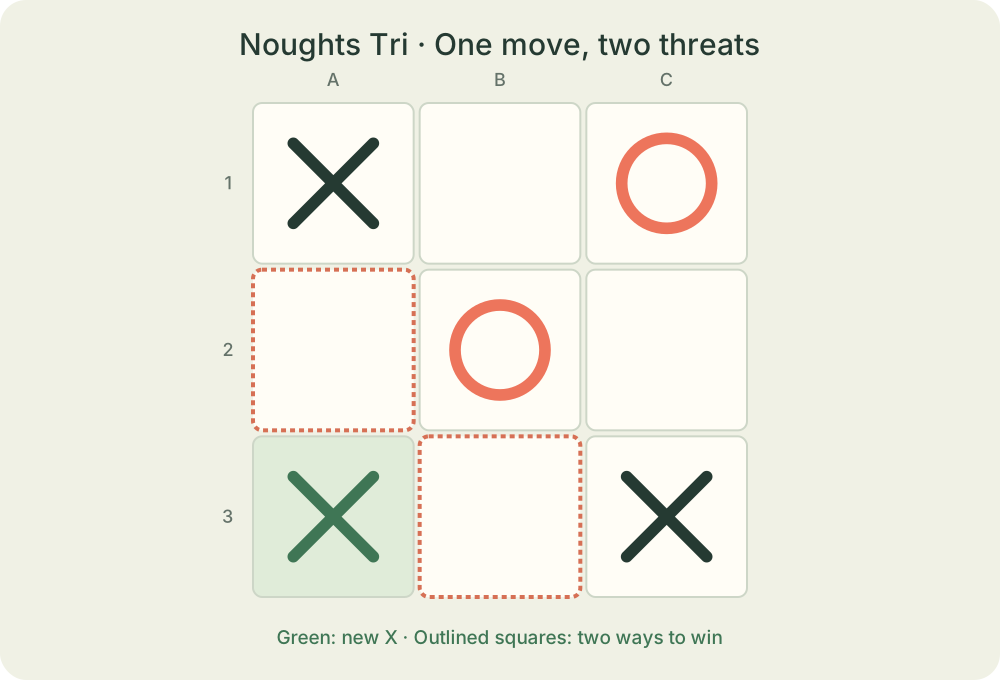
In the diagram, X is to move. X already occupies the top-left and bottom-right corners; O has the top-right corner and the centre. O threatens the bottom-left square along the diagonal.
X plays bottom-left, blocking that diagonal and creating two threats: the middle-left square completes the left column, while the bottom-middle square completes the bottom row. O cannot block both. The green X is the move to make; the outlined squares are the two possible finishes.
Why Expert can draw even when you play well
Classic 3×3 tic-tac-toe is a draw with perfect play from both sides. A draw against Tri Expert is a successful defence, not evidence that you missed a guaranteed winning trick.
Our Casual opponent deliberately misses some blocks. Thoughtful usually takes wins and blocks, but can make mistakes. Tri Expert searches the classic game to its conclusion. There is no legitimate strategy that guarantees beating a perfect opponent.
Practise the decisions, then chase your time
Try one round in which you say your reason before each move: win, block, fork, prevent a fork, or improve a useful line. This turns fast tapping into a skill you can repeat.
Once the checks feel natural, try beating your best winning time on Casual or Thoughtful. Only your thinking time counts; the computer’s wait is excluded. Times are separate for every board and difficulty and stored in this browser. Draws, losses and two-player games do not set winning records.
Frequently asked questions
Is noughts and crosses the same as tic-tac-toe?
For the classic 3×3 game, yes. They are familiar British and American names for the same placement game.
Can I play two players on one device?
Yes. Choose A friend and take turns on the same screen. X goes first; in computer games you swap marks each round.
How many lines can win on a 3×3 board?
Eight: three rows, three columns and two diagonals.
Can I always win if I go first?
No. Going first does not guarantee a win against correct defence. Both players can secure a draw with perfect play.
Explore the history, names and boards of noughts and crosses →