Noughts Quint
A little classic. One more go?
Four in a row to win · 5 × 5
Spots a win, sometimes misses a block. Very beatable.
How to play
Four in a row wins: across, down or diagonally. Tap an empty square to place your mark.
X always goes first. You swap marks each round, so you and the computer take turns starting.
Playing with a friend? Pass the device between turns. No account or waiting room needed.
Changing opponent or difficulty starts a fresh match and clears the score.
Against the computer, the clock counts only your thinking time and pauses when you leave the tab. Only wins count towards personal bests, saved separately for each board and difficulty in this browser. The sand is a gentle animation, not a time limit.
How to play Noughts Quint well
Quint gives you twenty-five squares, but you still need just four in a row. That small change makes a big difference: a winning line can sit inside the board rather than stretch from edge to edge.
Four in a row, anywhere it fits
Quint is Noughts’ own 5×5 variant with four contiguous marks needed to win. A line can be horizontal, vertical or diagonal, including diagonals that do not pass through the centre. Gaps do not count.
There are twenty-eight possible four-square winning segments. A five-square row contains two overlapping segments, so you can often build a threat without committing to one particular end.
Keep both ends of a line available
Three adjacent marks with an empty square at each end can be decisive. On an otherwise empty row, a run on B3, C3 and D3 threatens both A3 and E3. The opponent cannot occupy both ends in one turn.
Check the rest of the board first: a double-ended attack does not help if your opponent can win immediately. You also need both finishing squares to be inside the board and genuinely empty. A board edge is not an extra free square.
Why the middle helps, but is not a commandment
The central square belongs to eight different four-square segments. That gives it plenty of potential, especially early on. Its value falls when enemy marks close those segments.
Work outwards from useful intersections. A loose collection of marks near the centre is not automatically stronger than a connected attack near an edge. The question is how many credible continuations remain, not how tidy the position looks.
A worked crossing fork
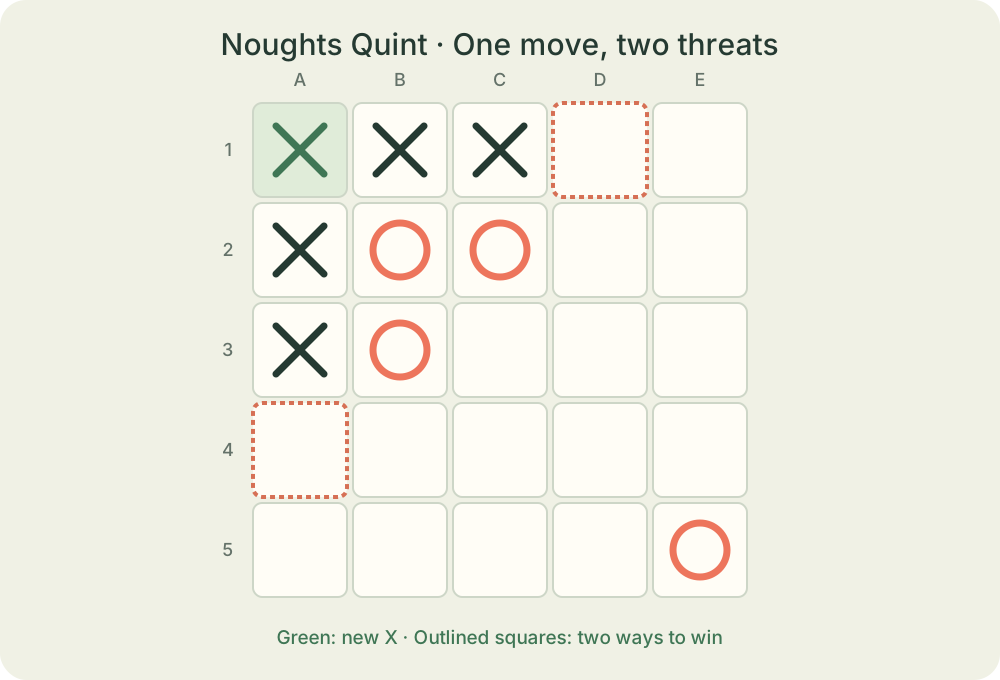
The diagram shows X on B1, C1, A2 and A3, with O on B2, C2, B3 and E5. X adds A1. D1 would now finish the top-row segment, while A4 would finish the left-column segment.
Notice that neither line needs to reach the far edge of the five-square board. This is the key difference from Quad. The green move makes two independent finishes; the outlined squares show what O cannot cover in a single reply.
Watch offset diagonals and forcing replies
Scan the board in four directions: across, down and along both diagonals. On Quint, concentrating only on the two corner-to-corner diagonals misses real winning lines.
Expert uses deeper search and double-threat checks; Casual leaves more room for mistakes. For practice, find every possible winning square before playing. For a speed attempt, shorten that routine rather than skip it. Your best winning time is kept separately from Tri, Quad and Hexa.
Frequently asked questions
Does Quint need five in a row?
No. Quint names the 5×5 board; this version needs four adjacent marks to win.
Does a line of five also win?
Yes. A line of five contains a line of four, so the game will already have ended when the fourth contiguous mark was placed.
Do diagonal lines have to cross the centre?
No. Any straight run of four inside the board counts.
Is this the same as Gomoku?
No. Quint uses a small 5×5 board and four in a row. Do not assume the rules of other alignment games apply here.
Explore the history, names and boards of noughts and crosses →