Noughts Hexa
A little classic. One more go?
Five in a row to win · 6 × 6
Spots a win, sometimes misses a block. Very beatable.
How to play
Five in a row wins: across, down or diagonally. Tap an empty square to place your mark.
X always goes first. You swap marks each round, so you and the computer take turns starting.
Playing with a friend? Pass the device between turns. No account or waiting room needed.
Changing opponent or difficulty starts a fresh match and clears the score.
Against the computer, the clock counts only your thinking time and pauses when you leave the tab. Only wins count towards personal bests, saved separately for each board and difficulty in this browser. The sand is a gentle animation, not a time limit.
How to play Noughts Hexa well
Hexa is the largest board in our Crosses family: thirty-six squares and five in a row to win. You have more space to plan, but a quiet-looking line can become dangerous surprisingly quickly.
Five in a row changes the rhythm
Hexa needs five contiguous marks in a straight line. Four is a warning, not a win. Horizontal, vertical and diagonal runs all count, including offset diagonals. There are thirty-two possible five-square winning segments on this board.
The game is called Hexa for its six-square sides. It is separate from Noughts Hex, our hexadecimal colour puzzle. Here, there are no number conversions: just X, O and the next move.
Build connected plans before advertising a threat
Early in a round, look for intersections between open lines. Two connected plans are harder to neutralise than one isolated run. Avoid investing in a segment that already contains an enemy mark.
With five marks required, a pair of neighbouring marks is still a long way from winning. Ask which empty squares could extend the pair and whether those extensions would create a useful second direction. Space is valuable when it leaves choices.
Understand an open four
Four adjacent marks with an empty square at each end make two immediate winning threats. For example, X on B3, C3, D3 and E3 can finish at either A3 or F3.
That pattern is dangerous only if the opponent does not already have an immediate win. When defending, try to close one end before the four is complete. Once both finishing squares are available, a single block is too late.
A worked five-in-a-row fork
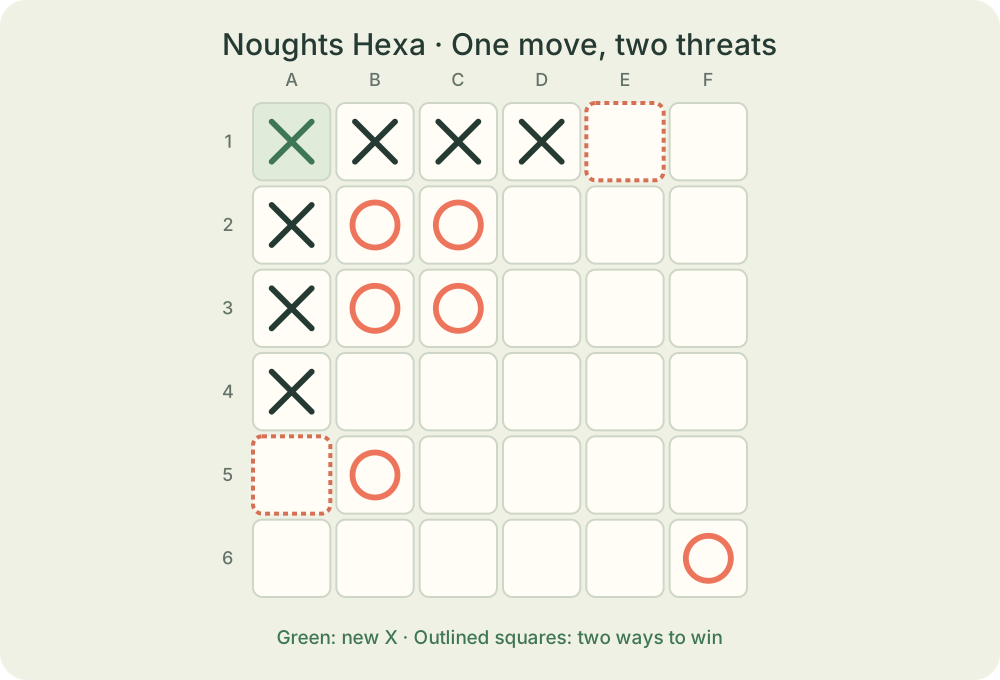
In our diagram, X occupies B1, C1, D1, A2, A3 and A4. O occupies B2, C2, B3, C3, B5 and F6. X plays A1.
The top-row segment now needs E1; the left-column segment needs A5. The same move has created two separate winning squares. Neither needs to reach the sixth square along that edge, and one O move cannot cover both.
Defend the whole board, then improve your pace
Before making a move, inspect every four-in-a-row threat, including the diagonals near the edges. Next, look for a move that would let the opponent create a fork. Finally, compare your own useful extensions.
Hexa Expert uses bounded deeper search, forcing-threat analysis and endgame calculation. The larger board creates more possibilities, so it is not described as unbeatable. Start by winning reliably at your chosen level; then aim to reduce your thinking time without rushing past a threat.
Frequently asked questions
How many marks win on Hexa?
Five adjacent marks horizontally, vertically or diagonally.
Is Hexa the same as Hex?
No. Hexa is a 6×6 noughts and crosses game. Noughts Hex is a separate colour puzzle using hexadecimal symbols.
Is it an official Gomoku or Renju ruleset?
No. Hexa is our small-board five-in-a-row variant. It does not implement tournament opening rules or forbidden-move rules.
Can I play for free without an account?
Yes. Play the computer or choose A friend for two players on one screen. Personal winning times stay in this browser.
Explore the history, names and boards of noughts and crosses →