Noughts Quad
A little classic. One more go?
Four in a row to win · 4 × 4
Spots a win, sometimes misses a block. Very beatable.
How to play
Four in a row wins: across, down or diagonally. Tap an empty square to place your mark.
X always goes first. You swap marks each round, so you and the computer take turns starting.
Playing with a friend? Pass the device between turns. No account or waiting room needed.
Changing opponent or difficulty starts a fresh match and clears the score.
Against the computer, the clock counts only your thinking time and pauses when you leave the tab. Only wins count towards personal bests, saved separately for each board and difficulty in this browser. The sand is a gentle animation, not a time limit.
How to play Noughts Quad well
Sixteen squares give your plans a little more room. Quad is our 4×4 noughts and crosses game, with four in a row to win and three very different computer opponents.
Four in a row means you need a longer plan
Only a complete row, column or one of the two long diagonals wins on Quad. Three marks are a threat if the fourth square is empty, but they are not a win. A line containing an opponent’s mark can no longer become your winning line.
Look for places where two open lines cross. One well-placed mark can improve both plans, leaving you less dependent on the opponent overlooking a single obvious row.
Count live lines rather than collecting marks
The four inner squares and four corners each belong to three winning lines. Other edge squares belong to two. There is no magic centre square on this even-sized board.
A square with three lines is only useful while those lines remain open. If two already contain an opponent’s mark, an apparently modest edge square with two live lines may do more for your position. Reassess the board after every reply.
Build a fork, not just a nearly finished row
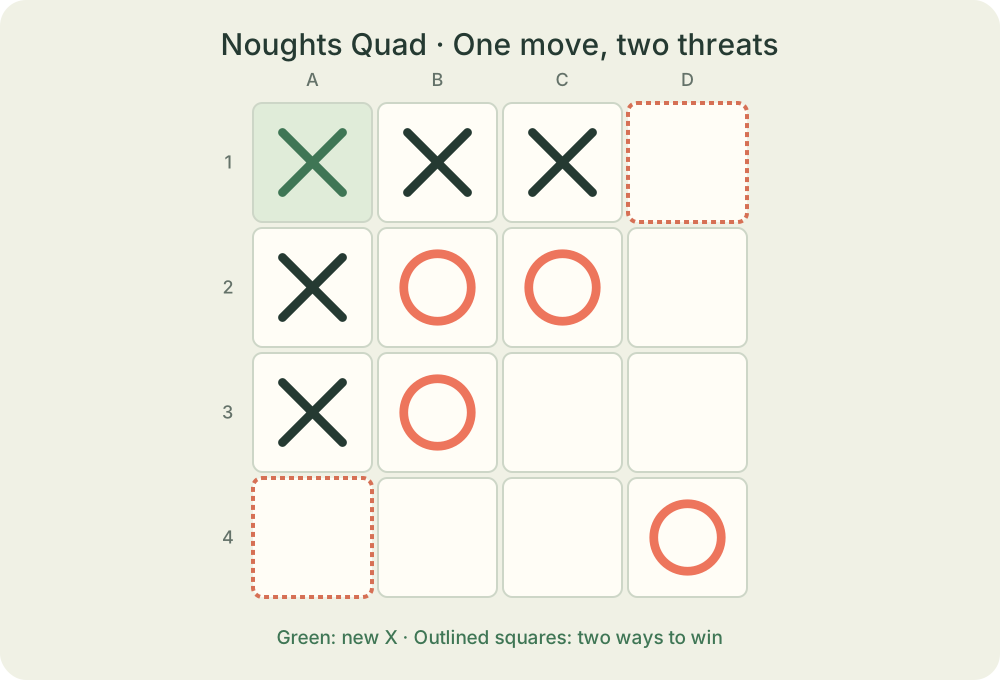
Quad’s illustrated position has X on B1, C1, A2 and A3; O is on B2, C2, B3 and D4. X plays A1. The top row now needs D1, and the left column needs A4.
Those are two different empty squares. Blocking D1 leaves A4; blocking A4 leaves D1. Two lines that both need the same empty square are only one threat, so count winning squares rather than impressive-looking lines.
Defending against the next trap
Always take a win or stop an immediate loss before following a longer plan. When there is no urgent finish, ask what your opponent could play next to create two winning squares.
Sometimes the strongest defence is to occupy the intersection before the fork appears. Sometimes a threat of your own forces a reply and buys a turn. A forcing move is useful only if it does not leave an immediate winning reply elsewhere.
What Expert does, and what to practise
Quad Expert searches ahead, recognises immediate double threats and follows compulsory blocks beyond its normal search horizon. As the board fills, it can examine longer continuations. It is a stronger opponent, not a promise of perfect play in every position.
Practise turning two open lines into a fork before chasing speed. Compare personal bests only within the same difficulty. A careful draw can be a better strategic performance than a quick win against an easier opponent.
Frequently asked questions
Do I need three or four in a row on Quad?
Four. A straight horizontal, vertical or diagonal line of four wins.
Can a short diagonal win?
No. On a 4×4 board, only the two diagonals that span the board contain four squares.
Is a draw possible?
Yes. If all sixteen squares fill without a winning line, the game is a draw.
Is Expert unbeatable?
We do not claim that. Quad Expert uses bounded search and tactical checks; Tri Expert is the version that plays the small classic game perfectly.
Explore the history, names and boards of noughts and crosses →